1
Member of the faculty of the Institute of Humanities and Cultural Studies. Western Studies and Science Research Institute
2
. Master's student, Shahid Beheshti University, Faculty of Literature, Department of Philosophy, Tehran, Iran.
3
. Professor of the Department of Philosophy, Faculty of Literature, Shahid Beheshti University.
Abstract
More than a century has passed since Iranians encountered and became familiar with Hegel's thought. During this period, the way "we" Iranians refer to Hegel has undergone changes, so after all this Hegel research and translation of Hegel's writings and reading of Hegel, we should evaluate the connection and relationship we have with Hegel and ask: do we Have we been able to intellectually own Hegel after all this? In other words, is it possible to mention an Iranian or Iranian-Islamic Hegel among the various interpretation traditions of Hegel, such as right and left, old and young, English and French, etc.? The answer to this question has various theoretical tools, one of the most important of which is the study of Hegel's thought in the context and tradition of Islamic philosophy. Since our dominant intellectual space in these two centuries has been Sadra'i, such readings mainly occurred in the context of Mulla Sadra's philosophy, so we also focused our work on evaluating Sadra's readings of Hegel. Motahari is one of the contemporary thinkers of the Sadrai tradition who welcomed Hegel in his works and studied Hegel with Sadrai principles.
Therefore, Motahari is one of the thinkers whose report and description of his encounter with Hegel is necessary to achieve the aforementioned purpose, and in this work, we seek to fulfill this necessity so that we can reach an accurate assessment of one of the most important interpretations of Sadra's Hegel.
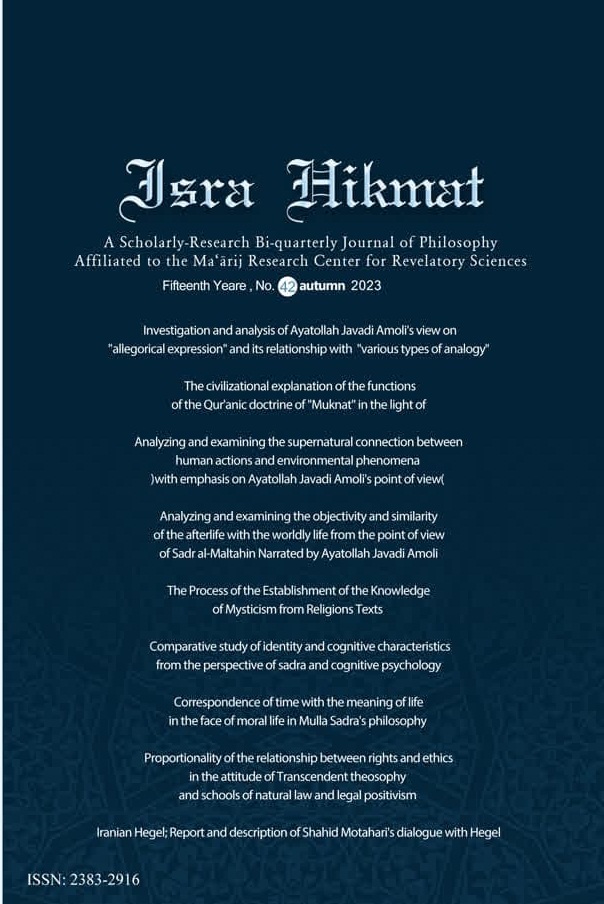
chawoshi,S. M. T. , Chavoshi,A. and Hekmat,N. (2023). Iranian Hegel; Report and description of Shahid Motahari's dialogue with Hegel. Isra Hikmat, 15(2), 277-312.
MLA
chawoshi,S. M. T. , , Chavoshi,A. , and Hekmat,N. . "Iranian Hegel; Report and description of Shahid Motahari's dialogue with Hegel", Isra Hikmat, 15, 2, 2023, 277-312.
HARVARD
chawoshi S. M. T., Chavoshi A., Hekmat N. (2023). 'Iranian Hegel; Report and description of Shahid Motahari's dialogue with Hegel', Isra Hikmat, 15(2), pp. 277-312.
CHICAGO
S. M. T. chawoshi, A. Chavoshi and N. Hekmat, "Iranian Hegel; Report and description of Shahid Motahari's dialogue with Hegel," Isra Hikmat, 15 2 (2023): 277-312,
VANCOUVER
chawoshi S. M. T., Chavoshi A., Hekmat N. Iranian Hegel; Report and description of Shahid Motahari's dialogue with Hegel. Isra Hikmat, 2023; 15(2): 277-312.